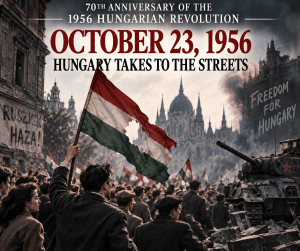
 Budapest, Hungary — October 23, 1956
This morning they are students.
They are not soldiers.
They are young Hungarians who want change.
The night before, university students in Budapest drew up sixteen demands. They want political reforms. They want freedom of the press. They want Soviet troops out of Hungary.
Today they are taking those demands into the streets.
At first, the demonstration is peaceful.
Students march through Budapest.
Then other Hungarians begin joining them.
Workers leave their jobs.
Men and women join the crowds.
People who have spent years being careful about what they say are suddenly shouting their demands in public.
The crowds grow larger and larger.
Budapest is no longer whispering.
Hungary is shouting.
By evening, the situation is becoming dangerous.
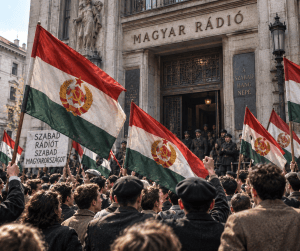
Demonstrators gather outside the Hungarian Radio building. They want their demands broadcast to the country.
The authorities refuse.
The crowd will not leave.
Then shots are fired.
ÁVH state-security forces inside the radio building fire on demonstrators.
People run.
People scream.
Some fall.
And something changes.
Hungarians who began this day as demonstrators now find themselves in the middle of violence.
Some Hungarian soldiers refuse to fire on their own people. Some soldiers join them.
The peaceful demonstration is becoming an uprising.
Night falls over Budapest.
Gunfire can be heard in the city. The Russians are killing the Hungarians.
Ordinary people who woke up this morning expecting to go to work, buy food, attend university or take care of their children are suddenly living inside a revolution.
Mothers try to get their children home.
Families stay away from windows.
People who have never been soldiers find themselves surrounded by gunfire.
And then comes the sound that makes everything more frightening.
Tanks.
During the night and into the early hours of October 24, Soviet troops move into Budapest.
Soviet tanks roll through the streets of the Hungarian capital.
Now the people of Budapest are no longer facing only their own government’s security forces.
They are facing the Soviet Army.
Streets that only hours earlier carried trams, workers and schoolchildren are becoming battlefields.
Buildings become places to hide.
Windows become dangerous.
People caught outside search for shelter.
Wounded and dead lie in streets where ordinary Hungarians had walked only hours earlier.
Throughout Budapest, loudspeakers and intercoms are broadcasting Radio Free Europe.
The message echoes through the city:
“We are the Americans. Keep fighting. We are coming to help. Keep fighting. We are coming to help.”
Hungarians hear it.
Józsi hears it.
America is coming.
Help is coming.
They believe it.
So they keep fighting.
This is no longer a political argument.
It is no longer simply students demanding reform.
Hungary is fighting.
And caught in the middle are ordinary Hungarian people.
Mothers.
Fathers.
Students.
Workers.
Grandparents.
Children.
People who never planned to become part of a revolution.
People who simply wanted Hungary to be free.
Across the country, families are hearing reports of what is happening in Budapest.
Nobody knows how far the fighting will spread.
Nobody knows what the Soviet Union will do next.
Nobody knows what Hungary will look like tomorrow.
One of those families is mine.
Józsi and Teri Szilágyi are my parents.
They have three small children: Dodi, Laci and sixteen-month-old Éva.
Me.
And this is where I stop telling you what happened to my family.
Because soon the Russians will come looking for Józsi.
Why?
What did my father do that caused the Russians to come looking for him?
And how did Józsi and the freedom fighters of Hungary become one of the Eleventh Arrow of Hungarian history?
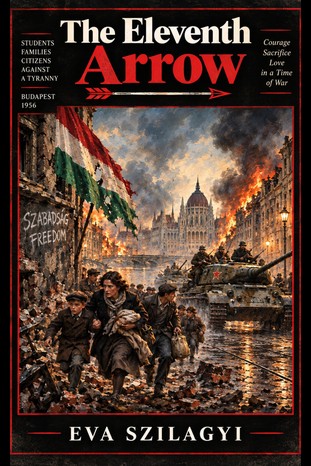
That is the story of The Eleventh Arrow.
Read the full story to discover what happened when the Hungarian Revolution turned Józsi and Teri’s family upside down.
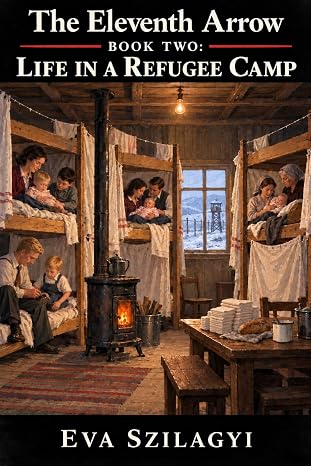
The Eleventh Arrow: Refugee Camp continues our family’s journey afterward, when escaping Hungary turns out to be only the beginning.
Seventy years later, I am still telling their story.
Éva Szilágyi
Author’s Note: The public events described here are based on the historical record of October 23 and the early hours of October 24, 1956. The Radio Free Europe broadcast is presented as it was heard and remembered by my father and passed down in our family. My family’s experiences during the Hungarian Revolution are told in The Eleventh Arrow.
The Eleventh Arrow
→ Purchase Paperback or Kindle Listen on Audible
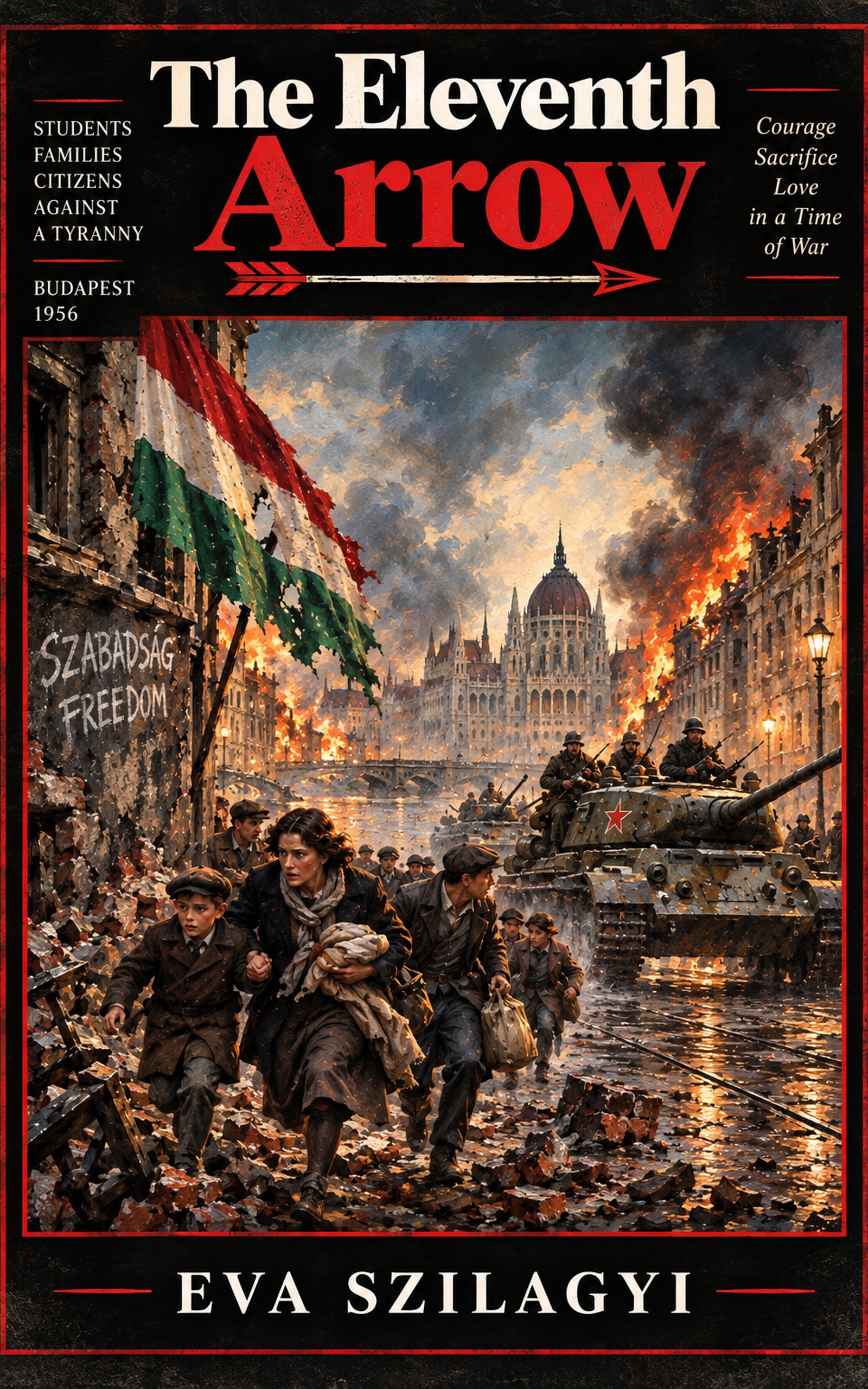
The Eleventh Arrow: Refugee Camp
→ Purchase Paperback or Kindle Listen on Audible